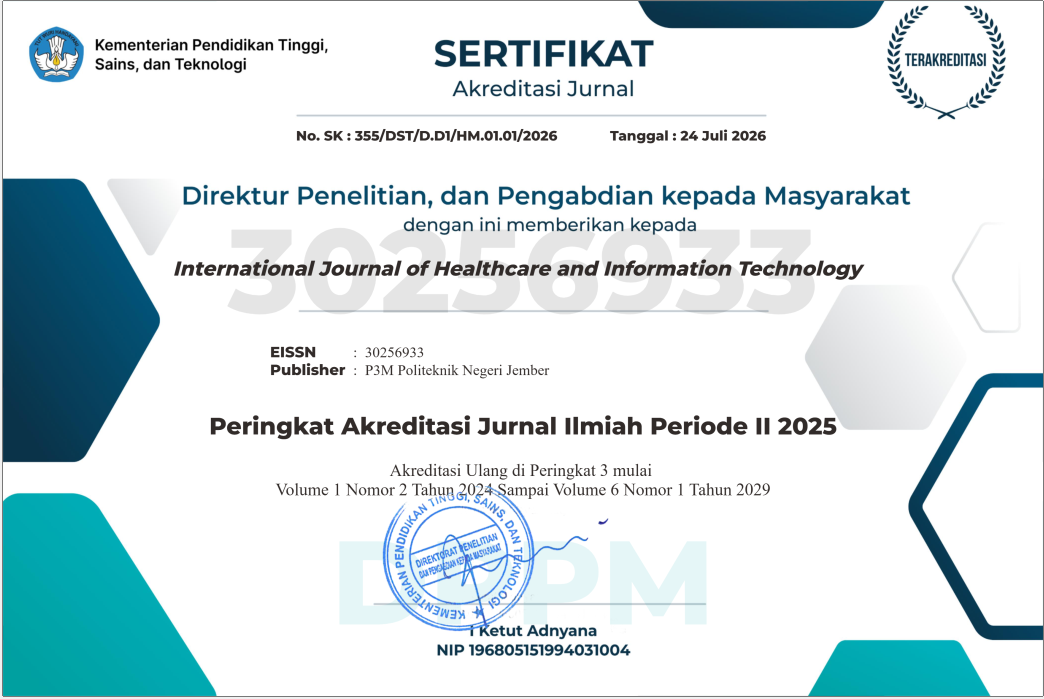
Aims & Scope
Aims
The International Journal of Healthcare & Information Technology (IJHITECH) is an international, peer-reviewed, open-access journal that provides a multidisciplinary platform for the dissemination of high-quality research, scientific knowledge, innovation, and practical developments in healthcare, information technology, and interdisciplinary research connecting these two domains.
The journal welcomes research addressing a broad range of topics in healthcare and health sciences, including clinical practice, nursing, midwifery, pharmacy, public health, mental health, health promotion, disease prevention, patient care, healthcare services, and evidence-based healthcare interventions.
The journal also welcomes research in information technology, including information systems, software engineering, artificial intelligence, machine learning, data science, computer science, information management, cybersecurity, Internet of Things, cloud computing, human-computer interaction, and emerging information technologies.
In addition, IJHITECH particularly encourages interdisciplinary research at the intersection of healthcare and information technology, including health informatics, digital health, healthcare information systems, intelligent healthcare, healthcare analytics, clinical decision support, connected care, and technology-enabled healthcare services.
The journal aims to provide an international forum for researchers, healthcare professionals, computer scientists, engineers, pharmacists, nurses, public health practitioners, information technology professionals, policymakers, and industry experts to exchange knowledge and disseminate research that contributes to advances in healthcare, information technology, and their meaningful integration.
Scope
The journal welcomes original research articles, review articles, systematic reviews, short communications, case studies, technological innovations, and other scholarly contributions covering, but not limited to, the following areas:
A. Healthcare
1. Clinical and Healthcare Practice
Clinical practice, patient care, healthcare services, evidence-based healthcare, clinical interventions, healthcare quality improvement, patient safety, clinical practice innovation, and healthcare service delivery.
2. Nursing, Midwifery, and Allied Health
Nursing practice, nursing education, midwifery, maternal and child health, community nursing, allied health sciences, healthcare professional practice, and innovations in health services.
3. Pharmacy and Pharmaceutical Care
Clinical pharmacy, pharmaceutical care, medication management, pharmacotherapy, pharmacy practice, medication safety, pharmaceutical services, and innovations in pharmaceutical healthcare.
4. Public Health and Population Health
Public health, epidemiology, health promotion, disease prevention, community health, environmental health, occupational health, population health, health education, health behavior, and health policy.
5. Mental Health and Behavioral Health
Mental health, psychological well-being, behavioral health, adolescent and adult mental health, stress and anxiety management, mental health promotion, preventive mental health interventions, and evidence-based behavioral healthcare.
6. Healthcare Interventions and Complementary Healthcare
Pharmacological and non-pharmacological interventions, preventive interventions, rehabilitation, complementary healthcare, alternative healthcare approaches, therapeutic interventions, and evaluation of healthcare interventions.
7. Biomedical and Health Sciences
Biomedical sciences, human health, physiology, pathology, laboratory sciences, clinical sciences, nutrition, health-related biological sciences, and other disciplines contributing to healthcare knowledge and practice.
B. Information Technology
8. Information Systems and Software Technology
Information systems, software engineering, software development, information system architecture, database systems, enterprise systems, web and mobile applications, system analysis and design, software quality, and information system evaluation.
9. Artificial Intelligence and Intelligent Computing
Artificial intelligence, machine learning, deep learning, natural language processing, computer vision, intelligent systems, knowledge-based systems, generative AI, intelligent agents, and other computational intelligence approaches.
10. Data Science and Analytics
Data science, big data, data mining, predictive analytics, statistical computing, business intelligence, data visualization, knowledge discovery, and data-driven decision-making.
11. Information Management and Digital Transformation
Information management, knowledge management, digital transformation, digital services, information governance, organizational information systems, digital innovation, and technology adoption.
12. Cybersecurity, Privacy, and Information Assurance
Cybersecurity, information security, data privacy, authentication, authorization, access control, cryptography, security management, privacy-preserving technologies, and information assurance.
13. Internet of Things, Cloud, and Emerging Technologies
Internet of Things (IoT), cloud computing, edge computing, distributed systems, blockchain, extended reality, digital twins, ubiquitous computing, and emerging information technologies.
14. Human-Computer Interaction and User Experience
Human-computer interaction, usability, user experience, accessibility, interaction design, user-centered design, technology acceptance, and evaluation of digital systems.
C. Healthcare & Information Technology
15. Health Informatics and Clinical Informatics
Health informatics, clinical informatics, nursing informatics, pharmaceutical informatics, biomedical informatics, consumer health informatics, translational informatics, clinical workflow optimization, and health knowledge management.
16. Healthcare Information Systems
Hospital Information Systems (HIS), Clinical Information Systems (CIS), Laboratory Information Systems (LIS), Radiology Information Systems (RIS), Pharmacy Information Systems, electronic prescribing systems, interoperability, HL7, FHIR, health information exchange, system integration, governance, and evaluation.
17. Electronic Health Records and Health Information Management
Electronic Health Records (EHR), Electronic Medical Records (EMR), personal health records, clinical documentation, medical coding and classification, health information quality, health data governance, health information auditing, and digital health documentation.
18. Digital Health and Connected Healthcare
Telemedicine, telehealth, eHealth, mobile health (mHealth), Internet of Medical Things (IoMT), wearable technologies, smart hospitals, remote patient monitoring, virtual care, digital therapeutics, patient engagement technologies, digital adherence systems, and connected healthcare.
19. Healthcare Artificial Intelligence and Data Science
AI in healthcare, machine learning for healthcare, healthcare data mining, predictive analytics, medical image analysis, clinical decision support systems, explainable AI, generative AI in healthcare, intelligent diagnostics, precision healthcare, and healthcare data science.
20. Healthcare Analytics and Decision Support
Healthcare analytics, health services research, health outcomes research, healthcare quality measurement, predictive modelling, operations research, business intelligence, evidence-based decision support, and data-driven healthcare management.
21. Healthcare Technology, Biomedical Engineering, and Smart Healthcare
Biomedical engineering, medical devices, biosensors, clinical engineering, rehabilitation technologies, assistive technologies, healthcare automation, medical robotics, digital medical instrumentation, smart healthcare environments, and intelligent healthcare equipment.
22. Health Data Security, Privacy, Ethics, and Governance
Healthcare cybersecurity, health data privacy, secure health information systems, access control, blockchain for healthcare, privacy-preserving technologies, ethical artificial intelligence, digital ethics, regulatory compliance, and governance of healthcare information.
23. Emerging Technologies for Healthcare
Cloud and edge computing for healthcare, IoT-enabled healthcare, digital twins, extended reality (AR/VR/MR), digital biomarkers, precision medicine technologies, next-generation healthcare platforms, and other emerging technologies supporting healthcare systems.
Interdisciplinary Focus
IJHITECH particularly encourages research that connects healthcare and information technology to address contemporary and emerging challenges.
Interdisciplinary topics may include, but are not limited to:
- digital transformation in healthcare;
- intelligent healthcare systems;
- technology-supported clinical practice;
- healthcare data analytics;
- AI-assisted healthcare;
- digital health services;
- connected and remote healthcare;
- healthcare decision-support systems;
- patient-centered digital services;
- health information management;
- healthcare cybersecurity and privacy;
- technology adoption in healthcare;
- digital innovation in health services; and
- emerging technologies applied to healthcare.